
Serbian Cursive Alphabet: Complete Handwriting Guide
Before learning cursive, make sure you know the Serbian Cyrillic alphabet in print form.
Serbian cursive handwriting looks quite different from printed Serbian Cyrillic. Letters that are clear in print—like Д, Т, or П—transform completely when handwritten. On top of that, Serbian has five unique letters (Ђ, Ћ, Љ, Њ, Џ) that don't exist in Russian, and each has its own cursive form you need to recognize.
This guide shows you exactly how the Serbian cursive alphabet differs from print. You'll see which letters change the most, learn the unique Serbian letters in cursive, recognize the confusing ones quickly, and understand the patterns that make Serbian cursive readable. Whether you need to read handwritten notes from Serbia or want to write in cursive yourself, start here.
Why Serbian Cursive Looks So Different
Serbian cursive developed for the same reason as Russian cursive: speed and flow. Instead of lifting the pen between letters, shapes connect smoothly. Over time, many letters simplified into curves and loops optimized for pen movement rather than visual similarity to print. The Serbian Cyrillic alphabet has 30 letters—fewer than Russian's 33—and shares most of its letters with Russian. Most shared letters transform in a broadly similar way to Russian cursive, though some — like г, п, and т — have their own regional variants.
What makes Serbian cursive distinctive is the five letters unique to Serbian: Ђ (đ), Ћ (ć), Љ (lj), Њ (nj), and Џ (dž). Two of these—Љ and Њ—are ligatures, formed by combining two letters into one. In cursive, these ligatures create shapes that don't exist in any other Cyrillic script. Understanding both the shared transformations and the unique letter forms is the key to reading Serbian cursive.
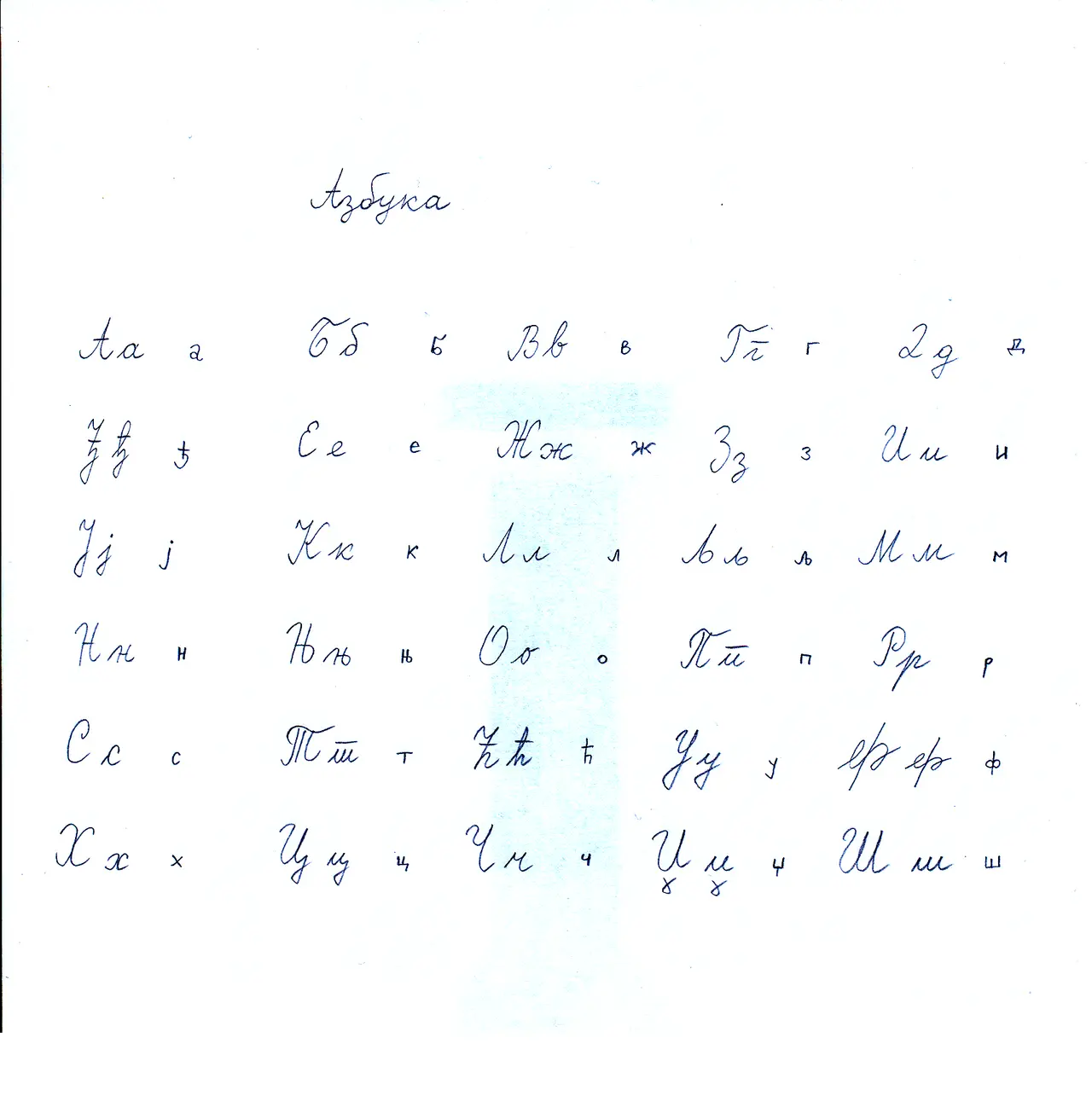
The Five Unique Serbian Letters in Cursive
These five letters exist only in Serbian Cyrillic (and closely related scripts like Macedonian). They don't appear in Russian, so learners familiar with Russian cursive still need to study them separately. Here's how each one works in cursive:
In print, Љ looks like a Л fused with a Ь. In cursive, the л shape (a rounded peak) flows directly into the ь shape (a small loop with a tail). The result is a single connected form with a peak followed by a loop. It sounds like "lli" in "million." Common confusion: in fast handwriting, љ can look like a standalone л followed by ь—context tells you whether it's one letter or two.
In print, Њ combines Н with Ь. In cursive, the н shape (which looks like an English "u" in cursive) flows into the ь loop. The result is a U-shape connected to a small loop with a tail. It sounds like "ny" in "canyon." Common confusion: like љ, it can be mistaken for two separate letters (н + ь) in messy handwriting.
In print, Ђ looks like a Д with a breve (˘) mark over it. In cursive, the base flows like cursive д (which looks like an English "g"), and the breve mark sits above it. The key is spotting the small mark above the "g" shape—it's what distinguishes ђ from д. Common confusion: if the breve is written small or omitted in fast handwriting, ђ becomes indistinguishable from д.
In print, Ћ looks like a Г with a horizontal bar and a small descender. In cursive, it becomes a flowing shape with a hook at the top and a small loop or tail at the bottom. It's more compact than Ђ and lacks the "g" shape. Common confusion: Ћ and Ђ are easy to mix up because they represent similar sounds (ć vs đ) and have somewhat similar shapes. Look for the "g" shape of ђ to tell them apart.
In print, Џ looks like a Ц with an added vertical bar, or a modified Ч. In cursive, it becomes a tall shape with a loop at the top and a descender below the line. It's one of the more distinctive cursive forms because of its height and the prominent loop. Common confusion: in cursive, џ can resemble ц or ч if the descender is short. Look for the tall loop to identify it.
Train Your Recognition Skills
Before diving into cursive, make sure you can recognize all the print Serbian Cyrillic letters confidently. Start with our interactive lessons to build your recognition skills.
Start Learning →The Five Most Confusing Letters
These five letters cause the most confusion for learners reading Serbian cursive. Four of them are shared with Russian and transform in a broadly similar way; the fifth is a Serbian-unique ligature. Master these and Serbian cursive becomes much easier to read:
The print Д has a distinctive shape, but in cursive it becomes a simple loop with a tail descending below the line—exactly like a lowercase "g" in English handwriting. This is a similar transformation to Russian cursive.
Print Т is a simple horizontal bar, but cursive т becomes a shape with two humps—indistinguishable from an English "m" at first glance. This is a similar transformation to Russian cursive.
The print П looks like a doorway, but cursive п simplifies to a single hump—identical to an English "n". This is a similar transformation to Russian cursive.
Print И has a diagonal stroke, but cursive и becomes a smooth U-shape, looking exactly like an English "u". This is a similar transformation to Russian cursive.
The Serbian-unique ligature Љ is confusing because in cursive it looks like a cursive л (a rounded peak) directly connected to a cursive ь (a small loop). In fast handwriting, it's hard to tell whether you're seeing one љ or two separate letters. This is a confusion that doesn't exist in Russian cursive at all.
Common Words in Serbian Cursive
Once you understand the confusing letters and the unique Serbian letters, practice with these common Serbian words. Notice how the letters connect—and pay special attention to words containing the unique letters:
Four connected humps—a similar pattern to Russian cursive
Both т letters look like "m"—reads like "mama" in cursive
Watch for the "g" shape of cursive д
Starts with the unique ligature љ—look for the peak + loop shape
Starts with the unique ligature њ—U-shape connected to a loop
Contains two ђ letters—look for the "g" shape with a breve mark above
Starts with ћ—distinguish it from ђ by the absence of the "g" shape
Notice the "w" shape of ш at the beginning
How to Practice Serbian Cursive
Reading cursive is different from writing it. Here's how to approach both:
For Reading Cursive
- • Focus on the five confusing letters first (д, т, п, и, љ)
- • Learn the unique Serbian letters (ђ, ћ, љ, њ, џ) before tackling full texts
- • Look for context clues—surrounding words help identify tricky letters
- • Practice with simple handwritten texts before tackling messy handwriting
- • Pay special attention to the breve mark on ђ—it's easy to miss in fast writing
For Writing Cursive
- • Start by tracing printed cursive examples
- • Practice the ligature letters (љ, њ) separately—they require a smooth transition between two shapes
- • Make the breve mark on ђ clearly visible, even when writing fast
- • Practice letter connections slowly before building speed
- • Use lined paper to maintain consistent height and descender length
- • Write common words repeatedly to build muscle memory
Russian Cursive: A Brief Note
Serbian and Russian cursive are broadly similar, since the two alphabets overlap heavily, though some shared letters have their own regional forms in each script. If you master Serbian cursive, you'll recognize most shapes in Russian cursive, but it's worth confirming a few rather than assuming an exact match. The main difference is that Russian lacks the five unique Serbian letters (Ђ, Ћ, Љ, Њ, Џ) and has a few letters Serbian doesn't (like Ы, Э, Ё, Й). For a full treatment of the shared transformations—especially the five most confusing letters—see our Russian Cursive Alphabet Guide.
Frequently Asked Questions
How is Serbian cursive different from Russian cursive?
Most shared letters (about 24 of the 30 Serbian letters) transform in a broadly similar way in both scripts, though a few — including г, п, and т — have their own regional cursive variants. The key difference is the five unique Serbian letters: Ђ, Ћ, Љ, Њ, and Џ. These don't exist in Russian and have their own cursive forms. Additionally, Russian has letters Serbian doesn't (Ы, Э, Ё, Й, Щ, Ъ, Ь used differently), but those don't affect Serbian cursive. If you know Russian cursive, you'll recognize most Serbian cursive shapes, though it's worth double-checking a few overlapping letters rather than assuming a 1:1 match.
Is Serbian cursive still taught in schools?
Yes. Serbian schools teach cursive handwriting from first grade, just as Russian schools do. Students learn cursive alongside print, and most Serbians write exclusively in cursive by hand. Typed text uses print letters, but handwritten notes, forms, and personal writing typically use cursive. The unique Serbian letters are taught as part of the standard curriculum.
Do I need to learn Serbian cursive if I already know Russian cursive?
You're most of the way there, but you still need to learn the five unique Serbian letters (Ђ, Ћ, Љ, Њ, Џ) in cursive. Most shared letters transform in a broadly similar way, so if you can read Russian cursive, you can read most Serbian cursive—though it's worth double-checking a few overlapping letters rather than assuming an exact match. Focus your effort on the ligature letters (Љ, Њ) and the similar-looking pair (Ђ, Ћ), which cause the most confusion. A few hours of focused practice on the unique letters is usually enough.
What's the difference between Ђ and Ћ in cursive?
Ђ (đ) and Ћ (ć) represent similar but distinct sounds, and their cursive forms reflect this. In cursive, ђ has the "g" shape of cursive д with a breve mark above it, while ћ has a more compact shape with a hook and small tail but no "g" form. The easiest way to tell them apart is to look for the "g" shape: if you see it, it's ђ; if you don't, it's ћ. The breve mark on ђ is also a key identifier, though it can be hard to spot in fast handwriting.
Master Print Letters First
Serbian cursive makes much more sense when you know the print alphabet well. Start by learning to recognize and read all 30 Serbian letters in their print form.
Learn the Serbian Alphabet →Serbian cursive handwriting takes practice, but it's not as intimidating as it first appears. Focus on recognizing the five most confusing letters, learn the five unique Serbian letters (Ђ, Ћ, Љ, Њ, Џ), practice with common words, and build your skills gradually. If you already know Russian cursive, you have a head start—just fill in the gaps with the unique letters. Even native speakers sometimes struggle with messy handwriting, so legibility matters more than perfection.