
Russian Cursive Alphabet: Complete Cyrillic Handwriting Guide
Before learning cursive, make sure you know the Russian Cyrillic alphabet.
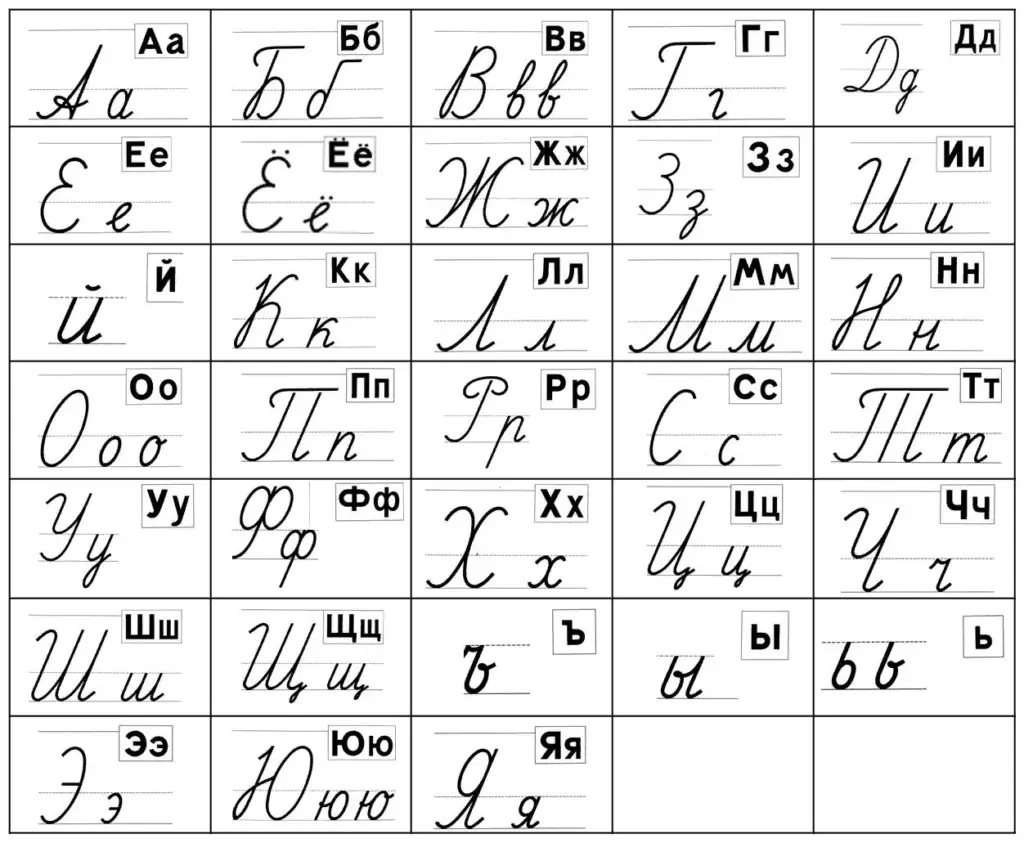
Russian cursive looks nothing like printed Cyrillic. Letters that seem straightforward in print—like Д, Т, or П—transform completely when handwritten. If you've tried reading Russian handwriting and felt lost, you're not alone.
This guide shows you exactly how the Russian cursive alphabet differs from print. You'll see which letters change the most, learn to recognize the confusing ones quickly, and understand the basic patterns that make cursive readable. Whether you need to read handwritten notes or want to write in cursive yourself, start here.
Why Russian Cursive Looks So Different
Russian cursive developed to make handwriting faster. Instead of lifting the pen between letters, shapes connect smoothly. Over time, many letters simplified into curves and loops optimized for pen movement rather than visual similarity to print. These transformations are the main reason the Russian cursive alphabet can feel confusing at first.
The Five Most Confusing Letters
These five letters cause the most confusion for learners. Master these and Russian cursive becomes much easier to read:
The print Д has a distinctive shape, but in cursive it becomes a simple loop with a tail descending below the line—exactly like a lowercase "g" in English handwriting.
Print Т is a simple horizontal bar, but cursive т becomes a shape with two humps—indistinguishable from an English "m" at first glance.
The print П looks like a doorway, but cursive п simplifies to a single hump—identical to an English "n".
Print И has a diagonal stroke, but cursive и becomes a smooth U-shape, looking exactly like an English "u".
Print Ш has three vertical strokes, but cursive ш flows into three connected humps—identical to an English "w".
Train Your Recognition Skills
Before diving into cursive, make sure you can recognize all the print Cyrillic letters confidently. Start with our interactive lessons to build your recognition skills.
Start Learning →Common Words in Russian Cursive
Once you understand the confusing letters, practice with these common Russian words. Notice how the letters connect:
Four connected humps—easy to confuse with other letter combinations
Looks like "nana" in cursive because п becomes "n"
Watch for the "g" shape of cursive д
Both т letters look like "m"—reads like "mum"
Notice the "w" shape of ш at the beginning
How to Practice Russian Cursive
Reading cursive is different from writing it. Here's how to approach both:
For Reading Cursive
- • Focus on the five confusing letters first (д, т, п, и, ш)
- • Look for context clues—surrounding words help identify tricky letters
- • Practice with simple handwritten texts before tackling messy handwriting
For Writing Cursive
- • Start by tracing printed cursive examples
- • Practice letter connections slowly before building speed
- • Use lined paper to maintain consistent height
- • Write common words repeatedly to build muscle memory
Serbian cursive is broadly similar to Russian, though some shared letters have their own regional cursive forms—and Serbian also includes five unique letters (Ђ, Ћ, Љ, Њ, Џ) that need their own treatment. For a full guide, see our Serbian Cursive Alphabet Guide.
Frequently Asked Questions
Why is Russian cursive so different from print?
Russian cursive evolved for speed and flow. When writing quickly by hand, letters naturally simplify and connect. The transformations that seem arbitrary (like Д → д) actually make writing faster—they're optimized for pen movement, not visual similarity to print.
Is Russian cursive still taught in schools?
Yes. Russian schools still teach cursive handwriting from first grade. Students learn cursive alongside print, and most Russians write exclusively in cursive by hand. Typed text uses print letters, but handwritten notes, forms, and personal writing typically use cursive.
Do I need to learn Russian cursive?
It depends on your goals. If you only read typed Russian (books, websites, signs), you can skip cursive. But if you'll interact with native speakers, read handwritten notes, or fill out forms in Russia, cursive becomes essential. At minimum, learn to recognize the five most confusing letters.
Master Print Letters First
Russian cursive makes much more sense when you know the print alphabet well. Start by learning to recognize and read all 33 Russian letters in their print form.
Learn the Russian Alphabet →Russian cursive handwriting takes practice, but it's not as intimidating as it first appears. Focus on recognizing the five most confusing letters, practice with common words, and build your skills gradually. Even native speakers sometimes struggle with messy handwriting—legibility matters more than perfection.